Mitai, Te Pā Tū, Te Puia or Whakarewarewa?
Four names come up whenever someone plans a cultural night in Rotorua, and they are less alike than the brochures make them look. Two are forest evenings with dinner. The other two are daytime visits, to a geyser valley with a carving school and to a village where people live. We set them side by side, price against price, with the catch in each.
Four ways to meet Māori Rotorua
Rotorua is home to Te Arawa, the people of the lakes, and Māori hosts have shown travelers around the steaming ground here for generations. Four experiences stand out today. Two are full evenings with dinner in a forest. The third is a geothermal valley with a carving school that also runs a night show. The fourth is a village where families still cook in the hot pools. Each one is led by Māori hosts, and none of them is a museum piece. Your choice mostly turns on two questions, which part of the day you have free and whether you want a meal in the price.
The four side by side
| Experience | From | When | Length | Food | Getting there | Rating |
|---|---|---|---|---|---|---|
| Mitai Māori Village (our pick) | ~$96 | Evening | About 3 h | Hāngī buffet with desserts | Pickup in Rotorua, or free parking | 4.7 GetYourGuide, 4.6 Viator |
| Te Pā Tū | ~$162 | Evening | 3–3.5 h | Forest canapés, then a three-course feast | Hotel pickup | 4.8 on both |
| Te Puia, Te Rā tour with haka | ~$80 | Day | 2 h | None | Drive yourself, free parking | 4.8 GetYourGuide, 4.9 Viator |
| Te Puia, Te Pō evening | ~$115 | Evening | About 2.5 h | Hāngī buffet with kai moana | See the listing | 4.7 on both |
| Whakarewarewa Living Māori Village | ~$25 | Day | 1 h | Corn cooked in a hot pool (GetYourGuide) | 17 Tryon Street, in town | 4.7 Viator, 4.6 GetYourGuide |
Prices are the regular "from" figure per adult, the lower of the two booking sites. Some list child rates, and the exact price shows once you pick a date.
Mitai, the evening by the stream
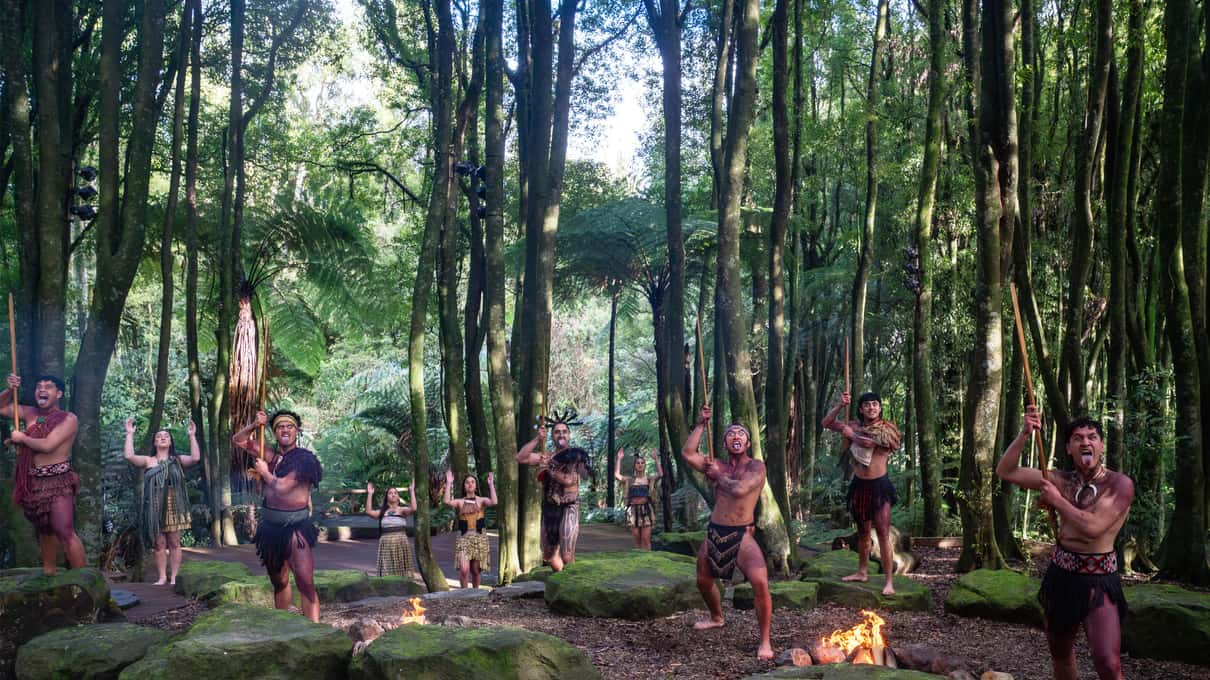
The Mitai Māori Village evening, from ~$96, is the one we would book first. It lasts about three hours at the edge of a forest a few minutes north of the center. Warriors paddle a carved war canoe down the Wai-o-whiro stream by torchlight, and you watch the hāngī come up out of its earth oven before a performance of haka and poi. Dinner is a buffet at shared tables. Afterward a guide walks you to the sacred spring, Te Puna Tapu o Tūhoe. Eels and trout drift in its clear water, and glowworms light the banks after dark. It holds 4.7 from 4,270+ reviews on GetYourGuide and 4.6 from 1,443+ on Viator.
The catch is scale. Mitai welcomes a big crowd on a busy night. Some guests in large groups struggled to see or hear, according to GetYourGuide's review summary, and a few asked for raised seating and clearer sound. The forest path has steps and uneven ground, and the glowworms are out of sight from the wheelchair-accessible area. What wins people over is the storytelling, which links village life of old to the Rotorua of today. Reviewers also praise the generous buffet and the easy talk that starts up between travelers sharing a table. The Mitai evening, step by step follows the night in order.
The forest evening with the waka
Three hours of waka and haka with a hāngī buffet, closing with a glowworm walk, from ~$96, with a ride from most Rotorua accommodation while seats last. Both sites cancel for free up to 24 hours before.
Te Pā Tū, dinner under the tawa trees
Te Pā Tū's evening with dinner, from ~$162, is the experience many travelers still know by its former name, Tamaki Māori Village. After a pōwhiri the night moves into a tawa forest lit by bonfires, with an amphitheater among the trees. The theme is the Maramataka, the Māori lunar calendar that told people when to plant and when to fish. Food is the headline here. Forest canapés come first, followed by three courses of seasonal fusion cooking designed by Māori chefs, with a vegetarian option. Hotel pickup is included, and it rates 4.8 on both booking sites. The catch is the bill, the highest of the four, and a set menu in place of a buffet, so big appetites cannot go back for seconds the way they can at Mitai.
Te Puia by daylight, or after dark
Te Puia sits on the southern edge of town in Te Whakarewarewa valley. Its star is Pōhutu Geyser, billed by the listing as the southern hemisphere's largest active geyser. The Te Rā day tour with a haka performance, from ~$80, starts with a 90-minute guided walk past the geyser terraces to the Kiwi Conservation Centre. From there you visit the New Zealand Māori Arts and Crafts Institute, where students train in carving and weaving. It finishes in the carved meeting house Te Aronui a Rua, where the performance opens with a pōhiri (the spelling Te Puia uses). It takes two hours in all and rates 4.8 on GetYourGuide. The catch is what it leaves out. There is no meal and no transport. GetYourGuide also flags it as unsuitable for wheelchair users. Pack a hat and water, since the valley paths are open to the sun.
The evening version is Te Pō, from ~$115. You watch the performance in Te Aronui a Rua, sip hot chocolate beside Pōhutu, then eat a hāngī buffet with kai moana (seafood) at the Pātaka Kai restaurant. Vegetarian and gluten-free options are listed. Its catch is length. At about 2.5 hours it runs shorter than Mitai, and the steaming valley takes the place of a forest walk, so you trade glowworms for geysers.
Whakarewarewa, a village people call home
On the other side of the same geothermal field, the Whakarewarewa Living Māori Village guided tour, from ~$25, comes cheapest of the four and feels the most personal. Families live here, cooking in the hot pools and steam vents, and the guides descend from the village guides who showed early travelers around. In an hour you see the marae and the historic churches, with lookouts toward Pōhutu, and the GetYourGuide ticket includes a corn cob cooked in a hot pool. The catch has two parts. You get no dinner, and you are a guest walking through somebody's neighborhood, so private homes stay private and cameras stay polite. Māori customs and words to know covers how to move as a guest.
Who should pick which
- One evening, first visit. Mitai pairs the waka with a hāngī buffet and the glowworm walk, for less than the other two dinners;
- A special dinner. Te Pā Tū, if the food matters as much as the show and the budget can stretch;
- Geysers plus culture in daylight. Te Puia's Te Rā tour, which also suits children who fade by 9 pm;
- Dinner beside the geysers. Te Pō, for a shorter night without the forest walk;
- A small budget or a curious mind. Whakarewarewa, for an hour with people who live on the steaming ground.
Accessibility differs too. Te Pā Tū and Te Pō are listed as wheelchair accessible. Mitai offers limited access, because its forest walk leaves by stairs.
Doing two in one trip
The day experiences last an hour or two, so pairing one with the Mitai evening is easy and the two hardly overlap. By daylight you see the geysers and a village that lives with the heat. After dark the war canoe takes over, followed by the earth oven and the glowworm walk. Te Puia and Whakarewarewa sit about 10 minutes from the center, the same as Mitai. Getting to Rotorua and to Mitai has the drive times. For the geothermal side in more depth, read Rotorua's geothermal parks compared. Mitai tickets and prices sets the evening against the other two dinners, while the hāngī dinner explained compares what each one serves. If you have two or three days, our Rotorua itinerary slots both in.